
Enterprise System Integration Guide | Connect Business Systems
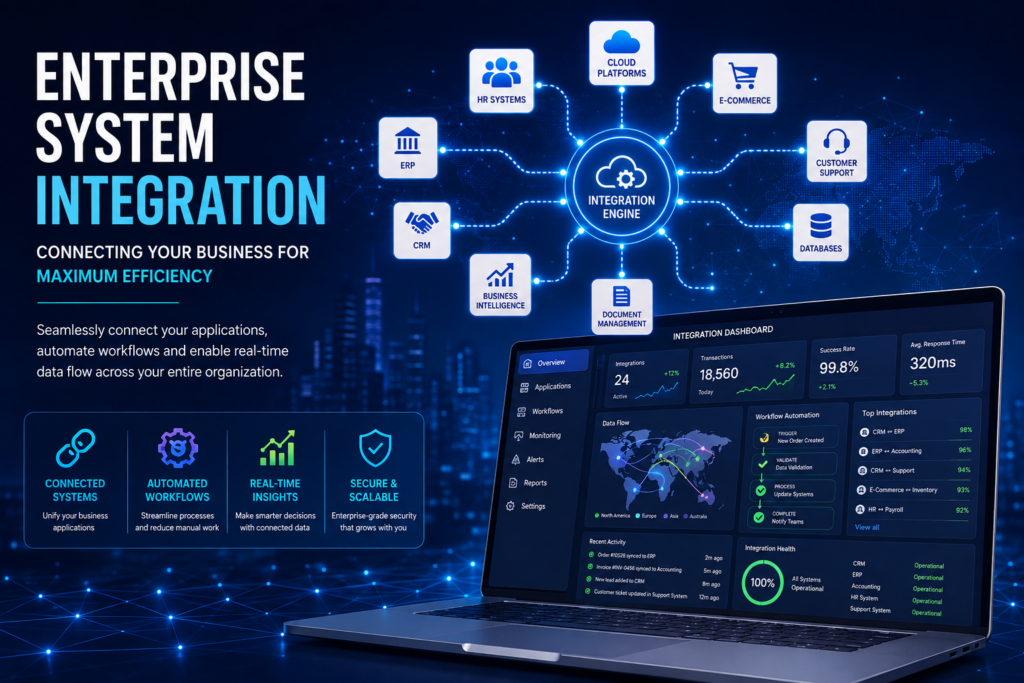
Modern businesses rely on a growing ecosystem of software applications to manage sales, finance, human resources, operations, customer support, marketing, inventory, and analytics. While these applications improve productivity individually, they often operate independently, creating disconnected systems that prevent information from flowing efficiently across the organization. As businesses grow, disconnected systems lead to duplicate data entry, inconsistent reporting, delayed decision-making, manual processes, and higher operational costs. Employees spend valuable time transferring information between applications instead of focusing on strategic work that drives business growth. Enterprise System Integration solves these challenges by connecting business applications through APIs, workflow automation, middleware, and cloud technologies. Instead of isolated software platforms, organizations create a connected digital ecosystem where information flows securely and automatically between systems. From integrating CRM platforms with ERP systems to synchronizing finance, HR, customer support, inventory, and cloud applications, Enterprise System Integration enables organizations to streamline operations, improve collaboration, eliminate data silos, and build a scalable foundation for digital transformation. In this guide, we’ll explore what Enterprise System Integration is, why it matters, how it works, its business benefits, implementation best practices, and how organizations can successfully connect their technology ecosystem. What Is Enterprise System Integration? Enterprise System Integration is the process of connecting multiple software applications, databases, cloud services, APIs, and enterprise platforms so they can securely exchange information and automate business processes. Rather than operating independently, integrated systems share data automatically, ensuring every department works with accurate, real-time information. Enterprise integration can connect: CRM Systems ERP Platforms Accounting Software HR Systems Payroll Applications Customer Support Platforms Marketing Automation Tools Inventory Management Systems E-commerce Platforms Business Intelligence Dashboards Cloud Applications AI Platforms This unified ecosystem enables organizations to automate workflows while reducing manual effort and improving operational efficiency. Why Enterprise Integration Matters Many organizations invest heavily in business software but fail to connect these systems effectively. This creates several operational challenges: Duplicate data entry Inconsistent customer information Delayed reporting Poor collaboration Manual approvals Data silos Increased operational costs Slow decision-making Limited business visibility Enterprise System Integration eliminates these barriers by creating seamless communication between applications, allowing data to move automatically and securely across the organization. Common Integration Scenarios Modern organizations commonly integrate: CRM + ERP Synchronize customer information, sales orders, invoices, and financial data. Accounting + Payment Gateways Automatically reconcile payments, invoices, and financial transactions. HR + Payroll Synchronize employee records, attendance, leave management, and payroll processing. E-commerce + Inventory Automatically update inventory levels, orders, shipping information, and customer records. Customer Support + CRM Connect support tickets with customer profiles for a complete view of every customer interaction. Marketing + Sales Platforms Automatically transfer qualified leads into CRM systems while tracking campaign performance. Document Management + Cloud Storage Centralize contracts, invoices, reports, and business documentation with secure cloud access. How Enterprise System Integration Works Enterprise integrations rely on modern technologies that allow applications to communicate securely. A typical integration workflow includes: A business event triggers an action. Data is collected from the source application. APIs or middleware securely transfer the information. Data is validated and transformed if required. Information is delivered to connected business systems. Automated workflows trigger follow-up actions. Dashboards provide real-time monitoring and reporting. This process eliminates manual intervention while ensuring business data remains accurate and synchronized. Business Benefits Organizations implementing Enterprise System Integration experience measurable improvements across their operations. Key benefits include: Eliminate duplicate data entry Improve data accuracy Accelerate business processes Increase employee productivity Strengthen collaboration Improve customer experiences Reduce operational costs Enable real-time reporting Improve decision-making Build scalable business operations Rather than maintaining disconnected software applications, organizations gain a unified digital infrastructure capable of supporting future growth. Industry Use Cases Manufacturing Manufacturers integrate ERP systems, production management, procurement, inventory, and logistics to improve operational visibility. Healthcare Healthcare organizations connect patient management systems, appointment scheduling, billing platforms, and clinical applications. Financial Services Financial institutions automate reporting, compliance monitoring, customer onboarding, and payment processing through secure integrations. Retail & E-commerce Retailers synchronize inventory, orders, payment gateways, customer information, and shipping platforms to improve customer experiences. Professional Services Consulting firms integrate CRM systems, project management software, accounting applications, document management, and reporting tools. Technology Stack Modern Enterprise Integration solutions commonly use: REST APIs GraphQL Webhooks Microsoft Power Automate n8n Make.com Zapier Python FastAPI Azure Integration Services AWS SQL Databases Salesforce HubSpot SAP Microsoft Dynamics 365 These technologies provide secure, scalable, and reliable enterprise integration capabilities. Implementation Best Practices Successful integration projects begin with careful planning. Recommended best practices include: Define business objectives. Document existing workflows. Map system dependencies. Prioritize security. Validate data quality. Implement monitoring and logging. Use scalable API architectures. Test integrations thoroughly. Continuously optimize performance. Following these practices reduces project risk while maximizing long-term business value. Why Choose AK Consultant LLC At AK Consultant LLC, we design and develop secure Enterprise System Integration solutions that connect business applications, automate workflows, and improve operational efficiency. Our expertise includes: Enterprise API Development Workflow Automation AI Agents Microsoft Power Platform CRM & ERP Integration OpenAI Integration Cloud Applications Custom Software Development AI SaaS Solutions Enterprise Architecture We build scalable integration solutions that eliminate manual work, improve data accuracy, and create connected digital ecosystems that support business growth. Frequently Asked Questions What is Enterprise System Integration? Enterprise System Integration connects business applications so they can securely exchange information and automate workflows. Can existing business systems be integrated? Yes. Most modern enterprise platforms provide APIs, webhooks, or integration connectors that enable secure communication. Is Enterprise Integration secure? Yes. Modern integrations use authentication, encryption, role-based access control, and secure APIs to protect business data. Can integrations scale as our business grows? Absolutely. Enterprise integration architectures are designed to support increasing users, applications, and transaction volumes. How long does implementation take? Implementation depends on the number of systems, integrations, and business requirements. Many organizations begin seeing benefits after their first integrations are deployed. Conclusion Enterprise System Integration is no longer optional for organizations pursuing digital transformation. By connecting business applications, eliminating data silos, and automating workflows, businesses improve operational efficiency, strengthen collaboration, and
AI Customer Support: The Complete Guide to Delivering 24/7 Exceptional Customer Experiences
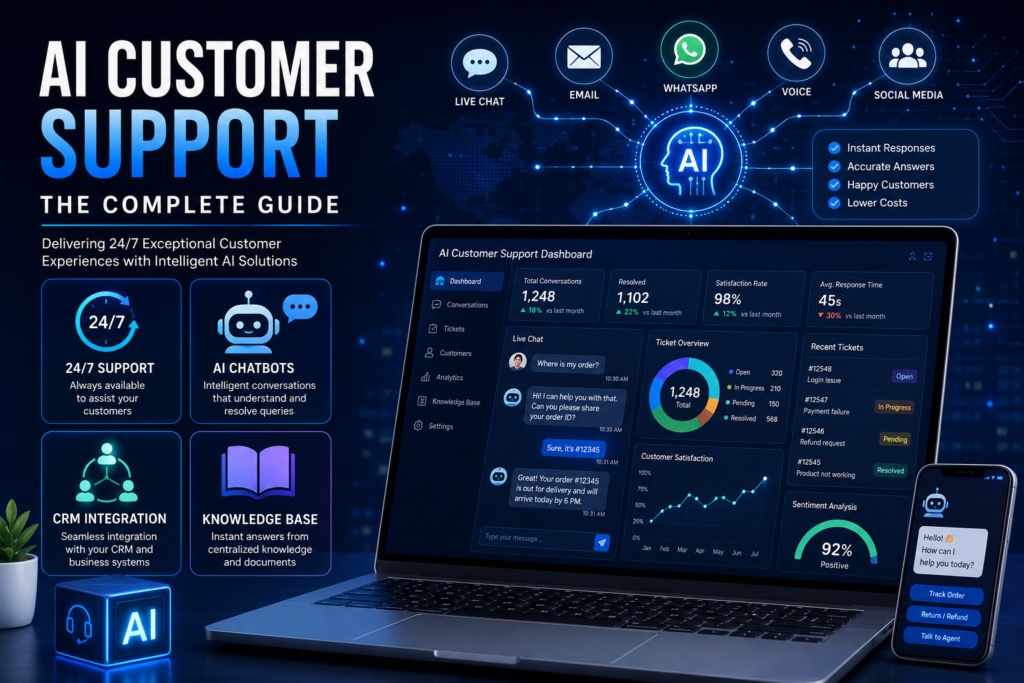
Customer expectations have changed dramatically over the past decade. Today’s customers expect businesses to respond instantly, provide accurate answers, and deliver consistent support across every communication channel—whether it’s a website, mobile app, email, live chat, or social media. Traditional customer support teams often struggle to meet these expectations due to increasing ticket volumes, repetitive enquiries, staffing limitations, and rising operational costs. As businesses grow, maintaining high-quality customer service becomes increasingly challenging. AI Customer Support enables organizations to automate customer interactions using Artificial Intelligence, Natural Language Processing (NLP), and intelligent automation while ensuring human agents remain available for complex conversations. Rather than replacing customer service teams, AI enhances their capabilities by handling repetitive tasks, improving response times, and delivering personalized customer experiences around the clock. From answering frequently asked questions and routing support tickets to integrating with CRM systems and analyzing customer sentiment, AI Customer Support is transforming how modern organizations engage with customers. In this guide, we’ll explore what AI Customer Support is, how it works, its business benefits, implementation best practices, real-world use cases, and how businesses can successfully deploy intelligent support solutions. What Is AI Customer Support? AI Customer Support is the use of Artificial Intelligence, machine learning, Natural Language Processing (NLP), and workflow automation to provide fast, intelligent, and personalized customer assistance. Unlike traditional chatbots that rely on predefined scripts, modern AI-powered support systems understand natural language, analyze customer intent, retrieve relevant information from knowledge bases, and generate meaningful responses. These intelligent systems can communicate through multiple channels including: Live Chat Email Voice Assistants WhatsApp Microsoft Teams Slack Mobile Applications Customer Portals AI Customer Support platforms integrate with existing business applications such as CRM systems, ticketing platforms, ERP software, and internal knowledge bases, enabling organizations to deliver seamless customer experiences without disrupting existing workflows. Challenges with Traditional Customer Service Many organizations continue to rely on manual customer support processes that become increasingly difficult to manage as customer demand grows. Common challenges include: Long customer wait times High support staffing costs Limited support availability Repetitive customer enquiries Inconsistent responses Knowledge sharing difficulties Slow ticket resolution Limited multilingual support Human errors Poor customer satisfaction These issues often lead to frustrated customers, increased operational expenses, and reduced business efficiency. AI Customer Support addresses these challenges by providing instant, consistent, and scalable customer assistance. How AI Customer Support Works Modern AI Customer Support solutions combine Artificial Intelligence with enterprise integrations to automate customer interactions from start to finish. A typical workflow includes: A customer submits a question through chat, email, or another communication channel. The AI identifies the customer’s intent using Natural Language Processing. Relevant information is retrieved from company knowledge bases, documentation, or business systems. The AI generates an accurate and personalized response. If required, customer information is updated within the CRM system. Complex enquiries are automatically escalated to human agents. Analytics dashboards monitor performance, customer satisfaction, and support metrics. This intelligent workflow enables businesses to deliver fast, reliable, and consistent support while reducing manual effort. Key Features Modern AI Customer Support platforms offer a wide range of intelligent capabilities, including: 24/7 customer assistance AI-powered conversational chatbots Voice AI assistants Multilingual conversations Knowledge base integration Intelligent ticket routing CRM integration Email automation Sentiment analysis Automated follow-ups Customer authentication Live agent handover Analytics and reporting dashboards Continuous AI learning These features enable businesses to provide enterprise-grade customer service while maintaining efficiency and consistency. Business Benefits Organizations implementing AI Customer Support often achieve measurable improvements across customer service operations. Key benefits include: Faster response times Reduced support costs Improved customer satisfaction Higher first-contact resolution rates Increased agent productivity 24/7 service availability Consistent customer experiences Reduced support workloads Improved scalability Better operational visibility Rather than replacing support teams, AI enables agents to focus on complex customer interactions while repetitive enquiries are handled automatically. Industry Use Cases Healthcare Healthcare providers automate appointment scheduling, patient enquiries, medical documentation requests, and administrative support while maintaining secure patient communication. Financial Services Banks and financial institutions use AI to answer account enquiries, assist with loan applications, provide transaction updates, and support compliance processes. Retail & E-commerce Retail businesses automate order tracking, returns, product recommendations, payment enquiries, and customer support across multiple sales channels. Logistics Logistics companies provide shipment tracking, delivery notifications, route updates, and customer communication using intelligent AI assistants. SaaS & Technology Software companies automate technical support, onboarding, documentation search, troubleshooting, and customer success workflows. Technology Stack Modern AI Customer Support platforms are built using enterprise-grade technologies such as: OpenAI Claude LangChain Python FastAPI Microsoft Power Platform Zendesk Salesforce HubSpot Intercom REST APIs Vector Databases Retrieval-Augmented Generation (RAG) Docker AWS Microsoft Azure These technologies enable secure, scalable, and intelligent customer support solutions. Implementation Best Practices Successful AI Customer Support implementation requires thoughtful planning and continuous optimization. Recommended best practices include: Identify frequently asked customer questions. Build a comprehensive knowledge base. Integrate existing CRM and business systems. Ensure secure handling of customer information. Train AI using accurate business documentation. Continuously monitor AI performance. Collect customer feedback. Improve responses through ongoing optimization. Organizations adopting a phased implementation approach typically achieve faster adoption and better long-term results. Why Choose AK Consultant LLC At AK Consultant LLC, we develop AI Customer Support solutions that help organizations improve customer experiences while reducing operational costs. Our expertise includes: AI Chatbots AI Agents Knowledge Base Systems CRM Integration Workflow Automation OpenAI Integration Microsoft Power Platform API Development AI SaaS Solutions Enterprise Software Development We build secure, scalable, and enterprise-ready AI solutions that integrate seamlessly with your existing business applications while delivering measurable improvements in customer satisfaction and operational efficiency. Frequently Asked Questions What is AI Customer Support? AI Customer Support uses Artificial Intelligence to automate customer interactions, answer enquiries, and assist support teams with intelligent workflows. Can AI answer complex customer questions? Yes. When connected to company knowledge bases and enterprise systems, AI can answer many complex business questions accurately. Does AI replace customer support agents? No. AI complements human agents by handling repetitive enquiries while allowing support teams to focus on more