
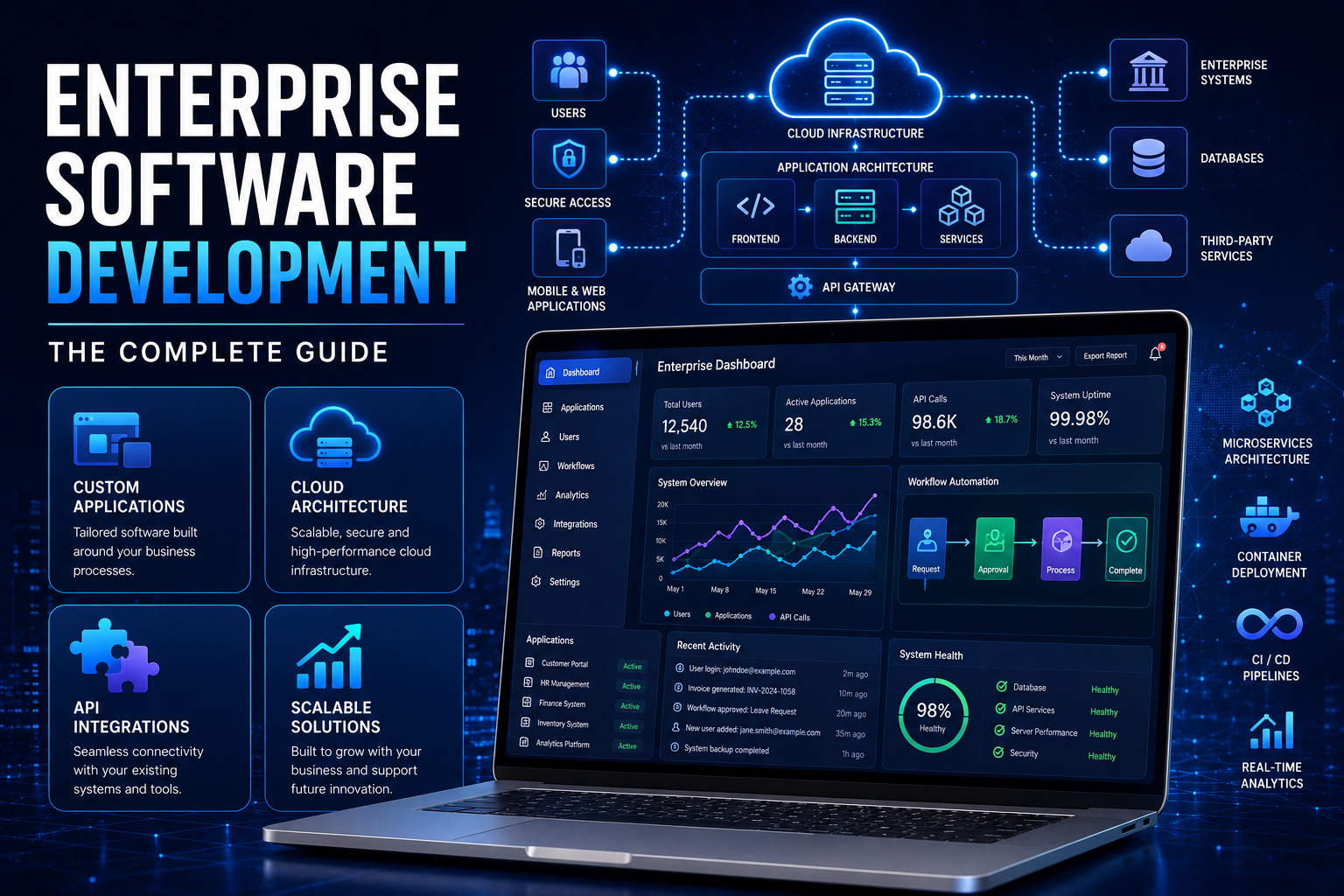
As businesses grow, their technology requirements become increasingly complex. Off-the-shelf software that once met operational needs often struggles to support unique workflows, industry-specific compliance requirements, and large-scale business operations. Organizations frequently find themselves adapting their processes to fit software limitations rather than using technology to improve efficiency and innovation.
This is where Enterprise Software Development becomes a strategic investment.
Enterprise software is designed specifically around an organization’s business objectives, operational processes, and long-term growth strategy. Unlike generic software solutions, custom enterprise applications integrate seamlessly with existing systems, automate complex workflows, improve collaboration across departments, and provide the scalability needed to support future expansion.
From customer portals and ERP systems to workflow automation platforms, AI-powered applications, and enterprise dashboards, custom software enables organizations to operate more efficiently while maintaining complete control over their technology ecosystem.
In this guide, we’ll explore what Enterprise Software Development is, how it differs from off-the-shelf software, its key business benefits, development lifecycle, implementation best practices, and how organizations can successfully build secure, scalable, and future-ready digital solutions.
What Is Enterprise Software Development?
Enterprise Software Development is the process of designing, developing, deploying, and maintaining custom software applications for medium and large organizations. These applications are built specifically to support business operations, integrate with existing enterprise systems, automate workflows, and improve overall productivity.
Unlike consumer software, enterprise applications are designed to handle thousands of users, large volumes of data, complex business rules, and strict security requirements.
Examples of enterprise software include:
- Enterprise Resource Planning (ERP) Systems
- Customer Relationship Management (CRM) Platforms
- Human Resource Management Systems
- Project Management Platforms
- AI Business Applications
- Workflow Automation Systems
- Financial Management Software
- Business Intelligence Dashboards
- Document Management Platforms
- Customer Self-Service Portals
These systems become the digital backbone of modern organizations by connecting departments, improving collaboration, and streamlining business operations.
Custom Software vs Off-the-Shelf Solutions
Many businesses begin with commercially available software because it is quick to deploy and relatively affordable. However, as organizations grow, these solutions often create limitations.
Off-the-Shelf Software
Commercial software provides standardized functionality designed to meet the needs of a broad audience.
Advantages include:
- Faster implementation
- Lower initial investment
- Regular vendor updates
- Established support
Limitations include:
- Limited customization
- Subscription costs
- Unnecessary features
- Difficult integrations
- Restricted scalability
Custom Enterprise Software
Custom software is designed specifically around an organization’s business requirements.
Benefits include:
- Tailored business workflows
- Seamless enterprise integrations
- Greater scalability
- Improved security
- Better user experience
- Complete ownership
- Competitive advantage
Instead of adapting your business to software, custom development creates software that adapts to your business.
Core Features of Enterprise Software
Modern enterprise applications combine advanced functionality with enterprise-grade security and scalability.
Common features include:
Role-Based Access Control
Ensure employees only access information relevant to their responsibilities.
Workflow Automation
Automate repetitive business processes such as approvals, notifications, reporting, and document routing.
API Integrations
Connect seamlessly with CRM systems, ERP platforms, payment gateways, cloud services, and third-party applications.
Reporting Dashboards
Provide real-time visibility into business performance through interactive analytics and reporting.
Document Management
Centralize business documents while maintaining secure access and version control.
Notifications
Automatically inform users about approvals, deadlines, updates, and important business events.
Audit Logging
Track user activities for compliance, security, and operational transparency.
Enterprise Security
Protect sensitive business information using authentication, encryption, permissions, and monitoring.
Enterprise Software Development Lifecycle
Successful enterprise software projects follow a structured development process that minimizes risk and ensures long-term success.
Discovery
Understand business goals, operational challenges, and project requirements.
Requirements Analysis
Document workflows, functional requirements, integrations, and technical specifications.
UI/UX Design
Create intuitive user experiences that improve productivity and adoption.
Architecture Planning
Design scalable, secure, and maintainable software architecture.
Development
Build the application using modern programming frameworks and cloud technologies.
Testing
Perform functional, security, integration, and performance testing before deployment.
Deployment
Launch the software within cloud, hybrid, or on-premise environments.
Training & Support
Provide user training, documentation, monitoring, maintenance, and continuous improvements.
Following this lifecycle ensures enterprise software remains reliable, scalable, and aligned with business objectives.
Business Benefits
Organizations investing in Enterprise Software Development achieve measurable operational improvements.
Key benefits include:
- Increased operational efficiency
- Reduced manual work
- Improved employee productivity
- Better collaboration
- Stronger security
- Enhanced reporting
- Greater scalability
- Seamless integrations
- Improved customer experiences
- Long-term cost savings
Custom software becomes a strategic business asset rather than simply another IT system.
Industry Use Cases
Healthcare
Healthcare providers build patient management systems, appointment platforms, medical record applications, and secure communication portals.
Manufacturing
Manufacturers develop production planning systems, inventory management platforms, procurement solutions, and quality control applications.
Logistics
Logistics organizations create fleet management software, shipment tracking systems, warehouse management applications, and route optimization platforms.
Financial Services
Banks and financial institutions automate compliance, reporting, risk management, customer onboarding, and transaction processing.
Professional Services
Consulting firms, legal practices, and accounting organizations build client portals, project management systems, workflow automation platforms, and document management applications.
Technology Stack
Enterprise Software Development uses modern technologies capable of supporting high-performance business applications.
Common technologies include:
- Laravel
- React
- Next.js
- Python
- FastAPI
- .NET
- PostgreSQL
- MySQL
- Docker
- Kubernetes
- Microsoft Azure
- AWS
- REST APIs
- GraphQL
- Enterprise Authentication Services
Selecting the right technology stack ensures long-term scalability, maintainability, and security.
Implementation Best Practices
Successful enterprise software projects require careful planning and continuous improvement.
Recommended best practices include:
- Define measurable business objectives.
- Involve stakeholders early.
- Adopt Agile development methodologies.
- Design scalable architecture.
- Prioritize cybersecurity.
- Integrate existing systems.
- Perform comprehensive testing.
- Monitor performance after deployment.
- Continuously improve based on user feedback.
Organizations following these practices reduce project risk while maximizing return on investment.
Why Choose AK Consultant LLC
At AK Consultant LLC, we design and develop secure, scalable enterprise software tailored to your organization’s unique business requirements.
Our expertise includes:
- Enterprise Software Development
- AI Business Applications
- Workflow Automation
- Enterprise API Integration
- AI SaaS Platforms
- Microsoft Power Platform
- OpenAI Integration
- Cloud Architecture
- Business Intelligence Solutions
- Ongoing Technical Support
We build enterprise applications that automate operations, improve collaboration, integrate business systems, and support long-term digital transformation.
Frequently Asked Questions
What is Enterprise Software Development?
Enterprise Software Development involves creating custom software applications designed specifically for business operations, workflows, and enterprise-scale requirements.
Why choose custom software instead of off-the-shelf solutions?
Custom software is designed around your organization’s unique processes, providing greater flexibility, scalability, and competitive advantage.
Can enterprise software integrate with existing business systems?
Yes. Modern enterprise applications integrate with CRM platforms, ERP systems, cloud services, payment gateways, and third-party software using secure APIs.
Is cloud deployment supported?
Absolutely. Enterprise applications can be deployed on Microsoft Azure, AWS, private cloud infrastructure, or hybrid environments.
How long does enterprise software development take?
Project timelines depend on complexity, integrations, and business requirements. Many organizations begin with an MVP and expand functionality through iterative development.
Conclusion
Enterprise Software Development enables organizations to modernize operations, automate business processes, improve collaboration, and build technology that grows alongside the business.
Rather than relying on software designed for everyone, custom enterprise applications provide organizations with solutions tailored to their unique operational needs, compliance requirements, and long-term strategic objectives.
Businesses investing in enterprise software today create a strong digital foundation that supports AI, automation, cloud technologies, and future innovation.
Ready to Build Enterprise Software Tailored to Your Business?
At AK Consultant LLC, we help organizations design, develop, and deploy enterprise software that streamlines operations, integrates business systems, automates workflows, and accelerates digital transformation.
Whether you’re planning a custom web application, enterprise portal, AI-powered business platform, or complete digital ecosystem, our team is ready to help bring your vision to life.
Book your free Discovery Call today and discover how Enterprise Software Development can transform your business.