
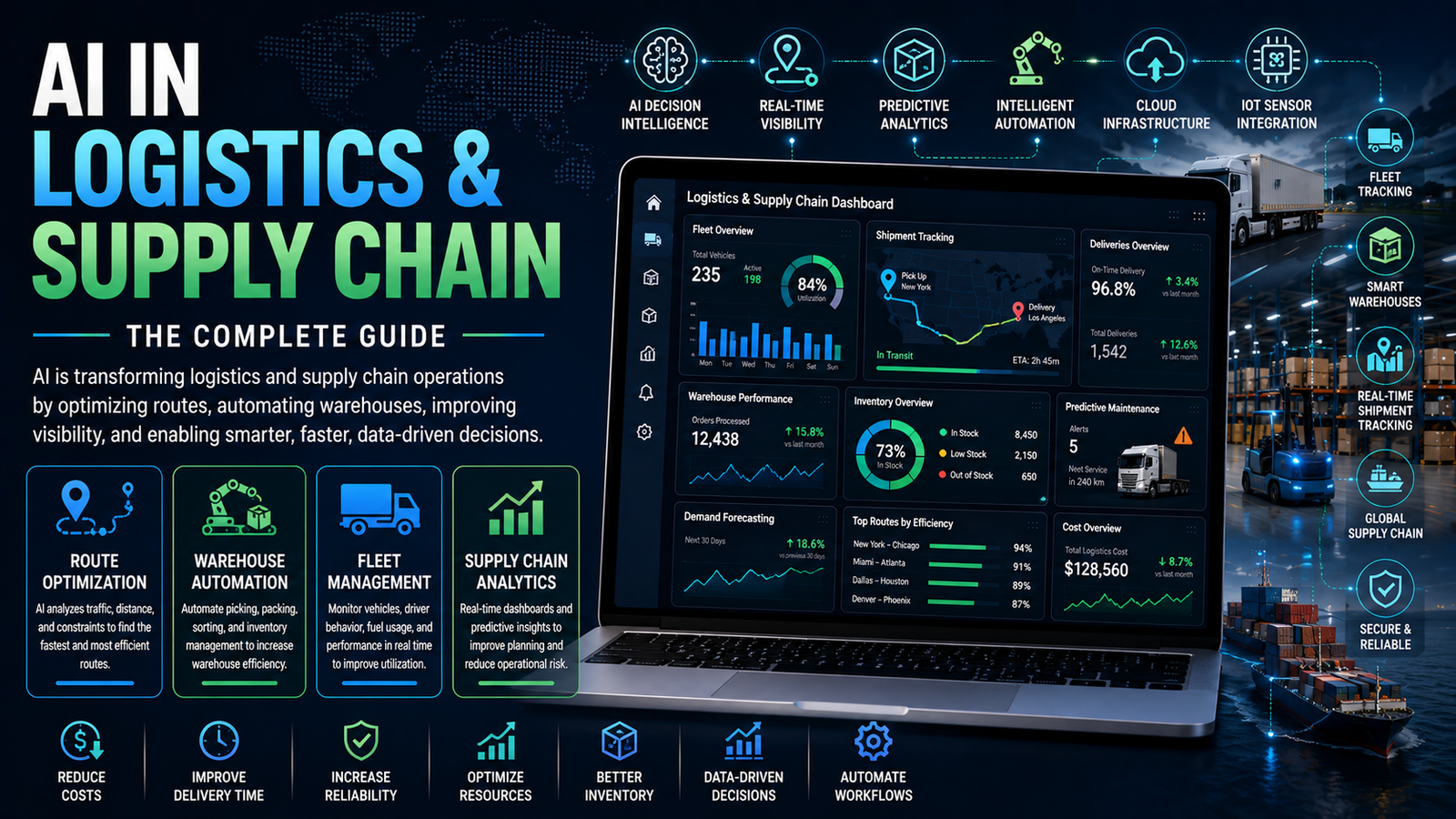
Global supply chains have become more complex than ever before. Logistics providers, manufacturers, distributors, retailers, and transportation companies must coordinate suppliers, warehouses, fleets, inventory, customers, and delivery networks across multiple regions while meeting increasing expectations for speed, visibility, and reliability. Rising fuel costs, labor shortages, changing customer demands, and supply chain disruptions have made operational efficiency a top priority for modern organizations.
Traditional logistics processes often rely on manual planning, disconnected systems, and reactive decision-making. As businesses grow, these methods become increasingly difficult to manage, leading to delayed shipments, excess inventory, inefficient routes, higher operating costs, and reduced customer satisfaction.
Artificial Intelligence (AI) is transforming logistics and supply chain management by helping organizations analyze operational data in real time, automate repetitive processes, optimize transportation, improve warehouse operations, predict future demand, and make faster, data-driven decisions. Rather than replacing logistics professionals, AI acts as an intelligent assistant that improves visibility, increases efficiency, and supports smarter operational planning.
From route optimization and fleet management to warehouse automation, predictive maintenance, shipment tracking, and demand forecasting, AI enables organizations to build more resilient, agile, and cost-effective supply chains.
In this guide, we’ll explore how AI is transforming logistics and supply chain operations, why organizations are investing in intelligent automation, common AI applications, implementation best practices, key challenges, and how businesses can successfully adopt AI-powered logistics solutions.
Why Logistics & Supply Chain Need AI
Modern logistics operations generate enormous volumes of operational data every day.
This information comes from:
- GPS tracking systems
- Fleet management platforms
- Warehouse management systems
- Inventory databases
- ERP software
- Transportation management systems
- IoT sensors
- Customer orders
- Supplier networks
- Delivery operations
Managing this information manually often results in slower decision-making and reduced operational efficiency.
Common business challenges include:
- Delivery delays
- Rising transportation costs
- Inefficient route planning
- Warehouse bottlenecks
- Excess inventory
- Stock shortages
- Poor supply chain visibility
- Vehicle downtime
- Manual reporting
- Limited forecasting capabilities
Artificial Intelligence helps organizations convert operational data into actionable insights that improve efficiency, reduce costs, and strengthen supply chain performance.
What Is AI in Logistics & Supply Chain?
AI in Logistics & Supply Chain refers to the use of Artificial Intelligence technologies to automate logistics operations, optimize transportation, improve warehouse management, forecast demand, and support intelligent business decision-making.
Instead of relying solely on historical reports, AI continuously analyzes operational data, transportation networks, customer demand, inventory levels, and external conditions to recommend better business decisions in real time.
AI enables logistics organizations to:
- Optimize transportation routes
- Improve fleet utilization
- Automate warehouse operations
- Predict customer demand
- Optimize inventory
- Improve shipment tracking
- Reduce operational costs
- Improve forecasting
- Increase delivery performance
- Strengthen supply chain visibility
These capabilities help organizations improve operational resilience while delivering faster and more reliable logistics services.
Key AI Applications
AI is transforming every stage of modern logistics and supply chain management.
Route Optimization
AI analyzes traffic conditions, delivery schedules, fuel consumption, weather, vehicle capacity, and customer locations to recommend the most efficient delivery routes.
This reduces transportation costs while improving on-time delivery performance.
Demand Forecasting
Machine learning models analyze historical sales, seasonal demand, customer behavior, and market trends to improve inventory planning and procurement decisions.
Better forecasting reduces inventory costs while improving product availability.
Warehouse Automation
AI automates warehouse operations including inventory movement, picking, packing, storage optimization, barcode scanning, and robotic assistance.
This improves warehouse productivity while reducing operational errors.
Inventory Optimization
AI continuously monitors inventory levels, supplier performance, lead times, and customer demand to optimize stock availability.
Organizations reduce excess inventory while minimizing stock shortages.
Fleet Management
AI monitors vehicle performance, fuel efficiency, driver behavior, maintenance schedules, and utilization rates to improve transportation efficiency.
Fleet managers gain real-time operational visibility across the entire transportation network.
Predictive Maintenance
AI analyzes vehicle performance and sensor data to identify maintenance issues before equipment failures occur.
This reduces downtime while extending vehicle lifespan and lowering maintenance costs.
Shipment Tracking
AI-powered tracking systems provide real-time shipment visibility, estimated delivery times, proactive notifications, and automated customer updates.
Customers receive accurate information throughout the delivery journey.
Delivery Scheduling
AI optimizes delivery schedules by considering customer availability, transportation capacity, warehouse operations, and route efficiency.
Scheduling automation improves customer satisfaction while increasing operational productivity.
Supply Chain Analytics
AI analyzes operational KPIs, supplier performance, inventory trends, transportation efficiency, and business performance through interactive dashboards.
Decision-makers gain real-time visibility across the entire supply chain.
Workflow Automation
Routine business processes including shipment approvals, purchase orders, inventory updates, delivery notifications, reporting, and documentation can be automated using intelligent workflows.
Benefits for Logistics Providers
Organizations implementing AI-powered logistics solutions experience measurable business improvements.
Key benefits include:
- Reduced transportation costs
- Improved delivery performance
- Better warehouse efficiency
- Increased fleet utilization
- Improved inventory management
- Better demand forecasting
- Reduced operational downtime
- Stronger supply chain visibility
- Faster decision-making
- Improved operational efficiency
AI enables logistics providers to create smarter, more agile supply chain operations while reducing operational complexity.
Benefits for Customers
Customers also benefit significantly from AI-powered logistics operations.
Common improvements include:
- Faster deliveries
- Accurate shipment tracking
- Reliable delivery estimates
- Better product availability
- Proactive delivery notifications
- Reduced shipping delays
- Improved customer communication
- Higher service reliability
- Greater transparency
- Better overall customer experience
AI improves customer satisfaction by providing more predictable, transparent, and responsive logistics services.
Technology Stack
Modern logistics AI platforms use enterprise-grade technologies designed to support global supply chain operations.
Common technologies include:
- OpenAI
- Claude
- Python
- FastAPI
- GIS Mapping Services
- Microsoft Power Platform
- REST APIs
- PostgreSQL
- IoT Platforms
- Cloud Infrastructure
- Workflow Automation Tools
- Enterprise ERP Integrations
These technologies allow logistics organizations to integrate AI with existing transportation, warehouse, and enterprise systems while supporting long-term scalability.
Implementation Best Practices
Successful AI implementation begins with clearly defined operational goals and high-quality logistics data.
Recommended best practices include:
- Integrate operational systems.
- Collect reliable logistics data.
- Define measurable KPIs.
- Automate repetitive workflows.
- Secure connected devices.
- Monitor AI performance continuously.
- Optimize processes based on operational insights.
- Expand AI capabilities gradually.
- Train logistics teams on AI-assisted workflows.
Organizations following these practices typically achieve stronger adoption and greater operational value.
Challenges and Considerations
AI implementation requires careful planning and operational readiness.
Logistics organizations should prepare for:
- Data quality improvements
- Legacy system integration
- Cybersecurity
- IoT device security
- Workforce training
- Change management
- Regulatory compliance
- AI model monitoring
- Continuous optimization
Addressing these challenges early improves implementation success while reducing long-term operational risk.
Why Choose AK Consultant LLC
At AK Consultant LLC, we help logistics providers implement secure AI solutions that automate operations, optimize transportation, improve warehouse performance, integrate enterprise systems, and support intelligent decision-making.
Our expertise includes:
- Logistics Workflow Automation
- AI Decision Intelligence
- Enterprise Software Development
- Enterprise ERP Integration
- Microsoft Power Platform
- API Integration
- Predictive Analytics
- Fleet Management Solutions
- Warehouse Automation
- Business Process Automation
We build scalable AI solutions tailored to logistics companies, transportation providers, warehouse operators, distributors, and supply chain organizations.
Frequently Asked Questions
Can AI optimize delivery routes?
Yes. AI analyzes traffic, weather, fuel consumption, delivery schedules, and operational constraints to recommend efficient transportation routes.
Can AI improve inventory management?
Yes. AI predicts customer demand, supplier performance, and inventory trends to optimize stock levels while reducing shortages and excess inventory.
Can AI integrate with existing logistics software?
Yes. Modern AI solutions integrate securely with transportation management systems, warehouse platforms, ERP software, GPS tracking systems, and enterprise applications using APIs and workflow automation technologies.
Is AI suitable for small logistics companies?
Absolutely. AI solutions can scale from small logistics providers to large global supply chain organizations depending on business requirements.
How long does implementation take?
Implementation timelines depend on operational complexity, existing infrastructure, system integrations, and business objectives. Many organizations begin with targeted automation projects before expanding AI across additional logistics operations.
Conclusion
Artificial Intelligence is transforming logistics and supply chain management by improving operational efficiency, optimizing transportation, increasing visibility, reducing costs, and enabling smarter business decisions. Organizations that strategically adopt AI gain a competitive advantage through better forecasting, stronger automation, improved customer service, and more resilient supply chain operations.
Rather than replacing logistics professionals, AI empowers teams with intelligent tools that improve productivity, enhance decision-making, and support long-term operational excellence.
Ready to Modernize Your Logistics & Supply Chain with AI?
At AK Consultant LLC, we help logistics providers implement secure AI solutions that automate workflows, optimize transportation, improve warehouse operations, integrate enterprise systems, and accelerate digital transformation.
Whether you’re looking to modernize fleet management, optimize warehouse operations, improve demand forecasting, or build AI-powered logistics applications, our team is ready to help.
Book your free Discovery Call today and discover how AI can transform your logistics and supply chain operations.