
The retail and e-commerce industry has changed dramatically over the past decade. Customers now expect personalized shopping experiences, instant product recommendations, accurate inventory information, fast delivery, seamless omnichannel interactions, and exceptional customer support across every touchpoint. At the same time, retailers face increasing competition, rising operational costs, changing consumer behavior, and complex supply chain challenges.
To remain competitive, businesses must do more than simply sell products—they must understand customer preferences, optimize inventory, automate operations, and make faster, data-driven decisions.
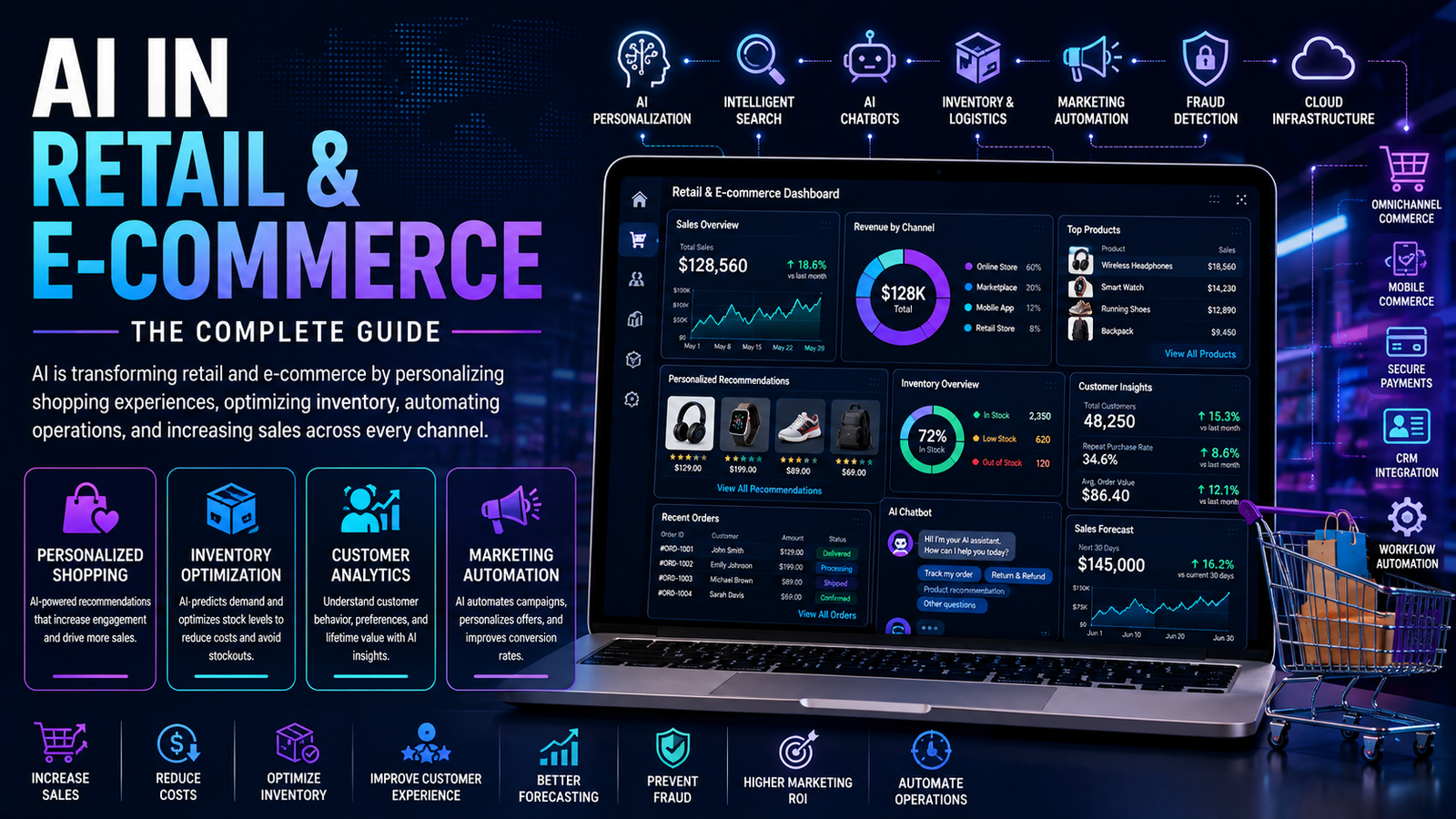
Artificial Intelligence (AI) is transforming retail and e-commerce by helping organizations analyze customer behavior, personalize shopping experiences, forecast demand, automate repetitive processes, optimize pricing strategies, and improve overall operational efficiency. Rather than replacing retail teams, AI serves as an intelligent assistant that enables businesses to deliver better customer experiences while reducing operational costs and increasing profitability.
From personalized product recommendations and intelligent search to inventory optimization, fraud detection, customer service chatbots, marketing automation, and predictive analytics, AI is becoming an essential part of modern retail operations.
In this guide, we’ll explore how AI is transforming retail and e-commerce, why businesses are investing in intelligent automation, common AI applications, implementation best practices, key challenges, and how retailers can successfully adopt AI-powered technologies.
Why Retail & E-commerce Need AI
Modern retailers generate enormous amounts of business data every day.
This information includes:
- Customer purchase history
- Product catalogs
- Inventory levels
- Website interactions
- Marketing campaigns
- Customer support requests
- Payment transactions
- Supply chain data
- Pricing information
- Sales performance
Managing this information manually makes it difficult to respond quickly to changing customer expectations and market trends.
Common business challenges include:
- Inaccurate demand forecasting
- Overstocking and stock shortages
- Cart abandonment
- Generic customer experiences
- High customer acquisition costs
- Slow customer support
- Manual inventory management
- Fraudulent transactions
- Inefficient pricing strategies
- Limited operational visibility
Artificial Intelligence transforms these challenges into opportunities by automating decision-making, improving forecasting, and delivering personalized customer experiences.
What Is AI in Retail & E-commerce?
AI in Retail & E-commerce refers to the use of Artificial Intelligence technologies to analyze customer behavior, automate retail operations, optimize inventory, improve marketing performance, and support intelligent business decision-making.
Instead of relying solely on historical reports, AI continuously analyzes customer interactions, sales data, inventory levels, and operational performance to provide real-time insights and recommendations.
AI enables retailers to:
- Personalize shopping experiences
- Improve product recommendations
- Optimize pricing
- Forecast customer demand
- Automate inventory management
- Improve customer service
- Detect fraudulent transactions
- Streamline fulfillment operations
- Optimize marketing campaigns
- Increase sales performance
These capabilities help retailers improve profitability while delivering better customer experiences across both physical and digital channels.
Key AI Applications
Retailers are implementing AI across nearly every part of the customer journey.
Personalized Product Recommendations
AI analyzes browsing history, purchase behavior, customer preferences, and shopping patterns to recommend products that are most relevant to individual customers.
This increases customer engagement, average order value, and overall sales.
Intelligent Search
AI-powered search helps customers quickly find products using natural language, voice search, image search, and predictive suggestions.
This improves product discovery while reducing abandoned searches.
Customer Service Chatbots
AI-powered virtual assistants provide instant support for order tracking, product information, returns, FAQs, and customer inquiries 24/7.
This improves response times while reducing customer service workloads.
Demand Forecasting
AI analyzes historical sales, seasonal trends, promotions, and market behavior to accurately forecast future demand.
Better forecasting helps retailers reduce stock shortages while avoiding excess inventory.
Inventory Optimization
AI continuously monitors inventory levels, warehouse operations, supplier performance, and customer demand to optimize stock availability.
This reduces storage costs while improving order fulfillment.
Dynamic Pricing Optimization
AI evaluates competitor pricing, customer demand, inventory levels, and market trends to recommend optimal product pricing that maximizes profitability while remaining competitive.
Fraud Detection
AI identifies suspicious purchasing behavior, unusual payment patterns, and fraudulent transactions before they impact the business.
This strengthens payment security and reduces financial risk.
Marketing Automation
AI personalizes email campaigns, customer segmentation, promotional offers, product recommendations, and advertising strategies based on customer behavior.
This improves marketing ROI while increasing customer engagement.
Sentiment Analysis
AI analyzes customer reviews, surveys, and social media conversations to identify customer satisfaction trends and opportunities for improvement.
Sales Forecasting
AI predicts future sales performance by analyzing historical transactions, seasonal demand, economic indicators, and promotional campaigns.
These forecasts help businesses improve financial planning and inventory management.
Benefits for Retailers
Organizations implementing AI-powered retail solutions experience measurable business improvements.
Key benefits include:
- Increased online sales
- Improved customer engagement
- Better inventory accuracy
- Reduced operational costs
- Higher marketing ROI
- Faster customer support
- Improved forecasting
- Reduced stock shortages
- Better fraud prevention
- Increased customer loyalty
Rather than replacing existing e-commerce systems, AI enhances operations by providing greater automation, intelligence, and operational visibility.
Benefits for Customers
Customers also benefit significantly from AI-powered shopping experiences.
Common improvements include:
- Personalized product recommendations
- Faster customer support
- Relevant promotional offers
- Accurate stock availability
- Quicker order processing
- Better product discovery
- Seamless omnichannel shopping
- Secure online payments
- Improved order tracking
- Higher customer satisfaction
AI enables retailers to create shopping experiences that are more convenient, engaging, and personalized.
Technology Stack
Modern retail AI platforms use enterprise-grade technologies designed to support scalable digital commerce.
Common technologies include:
- OpenAI
- Claude
- Python
- FastAPI
- Shopify
- WooCommerce
- Magento
- Microsoft Power Platform
- REST APIs
- PostgreSQL
- Cloud Infrastructure
- CRM Platforms
- Workflow Automation Tools
These technologies enable retailers to integrate AI with existing e-commerce platforms while supporting future business growth.
Implementation Best Practices
Successful AI implementation begins with clear business objectives and high-quality customer data.
Recommended best practices include:
- Integrate all sales channels.
- Centralize customer information.
- Collect accurate business data.
- Monitor key business KPIs.
- Secure payment information.
- Automate repetitive workflows.
- Continuously optimize AI models.
- Analyze customer feedback.
- Expand AI capabilities gradually.
Organizations following these practices typically achieve stronger AI adoption and higher business value.
Challenges and Considerations
AI implementation requires careful planning beyond technology alone.
Retailers should prepare for:
- Customer data quality
- Privacy protection
- Secure payment processing
- Legacy system integration
- Change management
- Workforce training
- Continuous AI monitoring
- Marketing optimization
- Regulatory compliance
Addressing these challenges early improves project success while reducing operational risks.
Why Choose AK Consultant LLC
At AK Consultant LLC, we help retailers and e-commerce businesses implement secure AI solutions that improve customer experiences, automate workflows, optimize inventory, and accelerate digital growth.
Our expertise includes:
- AI Customer Experience Solutions
- CRM & Sales Automation
- Workflow Automation
- Enterprise Software Development
- Shopify & WooCommerce Integrations
- Enterprise API Integration
- AI Decision Intelligence
- Marketing Automation
- Custom E-commerce Applications
- Business Process Automation
We build scalable AI solutions tailored to online retailers, omnichannel businesses, marketplaces, and enterprise commerce platforms.
Frequently Asked Questions
Can AI increase online sales?
Yes. AI improves product recommendations, personalizes shopping experiences, optimizes marketing campaigns, and increases customer engagement, all of which contribute to higher sales.
Can AI manage inventory?
Yes. AI analyzes demand patterns, supplier performance, and inventory levels to help businesses optimize stock management and reduce shortages.
Can AI integrate with existing e-commerce platforms?
Yes. Modern AI solutions integrate securely with Shopify, WooCommerce, Magento, CRM platforms, payment gateways, and enterprise systems through APIs.
Is AI suitable for small and medium-sized retailers?
Absolutely. AI solutions can scale to support businesses of all sizes, from small online stores to large retail enterprises.
How long does implementation take?
Implementation timelines depend on business size, existing systems, integrations, and project scope. Many retailers begin with targeted AI initiatives before expanding across additional business functions.
Conclusion
Artificial Intelligence is transforming retail and e-commerce by helping businesses deliver personalized shopping experiences, improve operational efficiency, optimize inventory, and increase profitability. Organizations that strategically adopt AI gain a competitive advantage through smarter decision-making, stronger customer engagement, and more efficient business operations.
Rather than replacing retail teams, AI empowers employees with intelligent tools that improve productivity, enhance customer satisfaction, and support long-term business growth.
Ready to Transform Your Retail & E-commerce Business with AI?
At AK Consultant LLC, we help retailers implement secure AI solutions that automate operations, optimize inventory, personalize customer experiences, integrate enterprise systems, and accelerate digital commerce.
Whether you’re looking to modernize your online store, automate marketing, improve inventory management, or build AI-powered retail applications, our team is ready to help.
Book your free Discovery Call today and discover how AI can transform your retail and e-commerce business.