
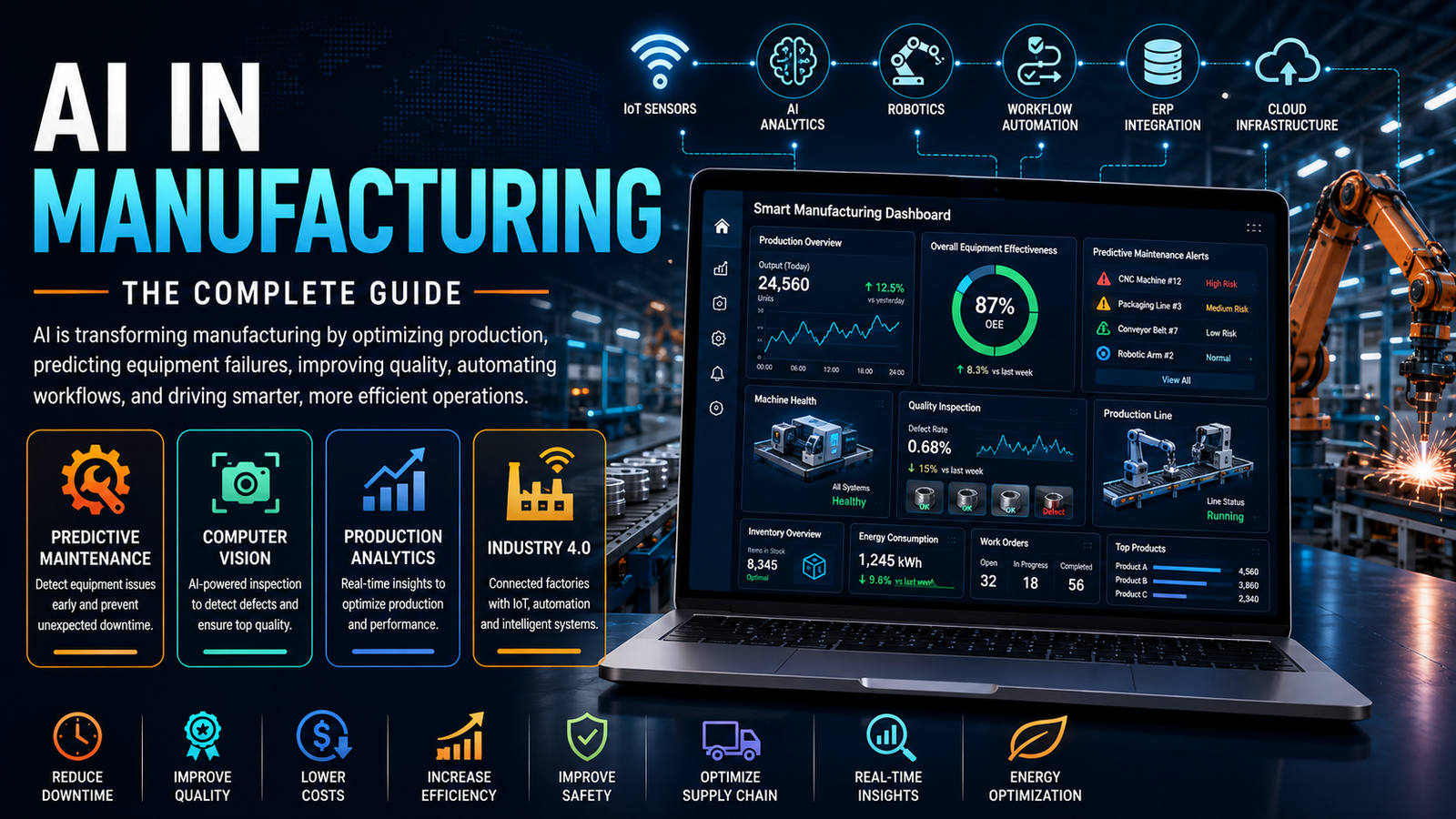
AI in Manufacturing: The Complete Guide to Building Smarter, More Efficient Operations
Manufacturing is entering a new era of digital transformation. Rising production costs, increasing customer expectations, global supply chain challenges, and growing competition are forcing manufacturers to rethink how they operate. Traditional production methods, while effective in the past, often struggle to deliver the speed, efficiency, flexibility, and quality required in today’s industrial environment.
Artificial Intelligence (AI) is helping manufacturers overcome these challenges by transforming raw operational data into intelligent business decisions. Modern factories generate enormous volumes of information from production equipment, sensors, ERP systems, warehouse operations, quality inspections, and supply chains. AI enables manufacturers to analyze this data in real time, automate repetitive tasks, predict equipment failures before they occur, optimize production schedules, improve quality control, and increase operational efficiency.
Rather than replacing engineers or production teams, AI serves as an intelligent decision-support system that helps organizations make faster, more informed decisions while reducing downtime, waste, and operational costs.
From predictive maintenance and computer vision to demand forecasting, inventory optimization, robotics, workflow automation, and AI-powered analytics, manufacturers are embracing Industry 4.0 technologies to create smarter, safer, and more efficient production environments.
In this guide, we’ll explore how AI is transforming manufacturing, why manufacturers are investing in intelligent automation, common AI applications, implementation best practices, key challenges, and how organizations can successfully adopt AI-powered manufacturing solutions.
Why Manufacturing Needs AI
Modern manufacturing facilities produce vast amounts of operational data every second.
This information comes from:
- Production machinery
- Industrial IoT sensors
- ERP systems
- MES (Manufacturing Execution Systems)
- Supply chain platforms
- Warehouse management systems
- Quality inspection processes
- Maintenance records
- Inventory systems
- Energy monitoring platforms
Despite having access to this information, many manufacturers still rely on manual analysis and reactive decision-making.
Common operational challenges include:
- Unexpected equipment failures
- Production delays
- High maintenance costs
- Product quality issues
- Excess inventory
- Supply chain disruptions
- Manual reporting
- Inefficient production planning
- Energy waste
- Limited operational visibility
Artificial Intelligence helps manufacturers transform operational data into actionable insights that improve productivity, reduce downtime, and support continuous operational improvement.
What Is AI in Manufacturing?
AI in Manufacturing refers to the application of Artificial Intelligence technologies to automate industrial operations, optimize production processes, improve equipment performance, support quality management, and enhance operational decision-making.
Instead of relying solely on manual monitoring, AI continuously analyzes production data to identify patterns, predict future outcomes, and recommend actions that improve operational performance.
AI enables manufacturers to:
- Predict equipment failures
- Improve production planning
- Detect quality issues
- Optimize inventory
- Automate workflows
- Improve energy efficiency
- Support supply chain planning
- Enhance operational reporting
- Increase workplace safety
- Enable data-driven decision-making
These capabilities allow manufacturers to improve efficiency while building more resilient and intelligent production environments.
Key AI Applications
Manufacturers are implementing AI across nearly every stage of the production lifecycle.
Predictive Maintenance
AI continuously monitors equipment performance using sensor data and historical maintenance records to identify potential failures before they occur.
This reduces unexpected downtime while lowering maintenance costs and improving equipment reliability.
Quality Inspection
Computer Vision powered by AI automatically inspects products for defects, inconsistencies, and quality issues during production.
Early detection improves product quality while reducing waste and rework.
Production Planning
AI analyzes production schedules, resource availability, customer demand, and operational constraints to optimize manufacturing planning and increase throughput.
Inventory Optimization
AI predicts inventory requirements based on historical demand, supplier performance, production schedules, and market trends.
This helps reduce excess inventory while avoiding stock shortages.
Demand Forecasting
Machine learning models analyze historical sales, customer demand, seasonal patterns, and market trends to improve production forecasting and supply chain planning.
Computer Vision
AI-powered vision systems monitor production lines, identify safety risks, inspect products, count inventory, and automate visual quality control.
Robotic Process Automation
AI automates repetitive administrative tasks including reporting, approvals, procurement workflows, production documentation, and operational data entry.
Workflow Automation
Manufacturing organizations automate approvals, maintenance requests, production scheduling, document routing, and operational notifications using intelligent workflows.
Energy Optimization
AI analyzes energy consumption across production facilities to identify inefficiencies and reduce operating costs while supporting sustainability initiatives.
AI Decision Support
Executives and plant managers use AI-powered dashboards to monitor production KPIs, equipment health, operational performance, inventory levels, and business trends in real time.
Benefits for Manufacturers
Organizations implementing AI-powered manufacturing solutions experience measurable operational improvements.
Key benefits include:
- Reduced equipment downtime
- Improved product quality
- Increased operational efficiency
- Lower maintenance costs
- Better inventory management
- Improved supply chain visibility
- Faster production planning
- Reduced manufacturing waste
- Improved workplace safety
- Better business decision-making
Rather than replacing existing manufacturing systems, AI enhances operations by improving visibility, automation, and operational intelligence.
Technology Stack
Modern manufacturing AI platforms are built using enterprise-grade technologies capable of supporting industrial environments.
Common technologies include:
- Python
- FastAPI
- OpenAI
- Claude
- Industrial IoT Platforms
- Microsoft Power Platform
- REST APIs
- PostgreSQL
- Cloud Infrastructure
- Machine Learning Frameworks
- Workflow Automation Platforms
- Enterprise ERP Integrations
These technologies enable manufacturers to integrate AI with existing production systems while supporting long-term scalability.
Implementation Best Practices
Successful AI implementation begins with clearly defined business objectives and a phased deployment strategy.
Recommended best practices include:
- Start with high-value production processes.
- Connect operational systems and industrial equipment.
- Collect accurate, high-quality production data.
- Define measurable KPIs.
- Secure industrial networks.
- Involve production teams early.
- Continuously monitor AI performance.
- Improve AI models over time.
- Expand AI implementation incrementally.
Organizations following these practices typically achieve faster adoption and stronger business outcomes.
Challenges and Considerations
AI implementation requires more than technology alone.
Manufacturers should prepare for:
- Legacy system integration
- Data quality improvements
- Workforce training
- Change management
- Cybersecurity
- Industrial network security
- Operational governance
- AI model monitoring
- Continuous optimization
Addressing these factors early increases project success while reducing implementation risks.
Why Choose AK Consultant LLC
At AK Consultant LLC, we help manufacturers implement secure AI solutions that optimize production, automate workflows, improve operational visibility, and support intelligent decision-making.
Our expertise includes:
- Manufacturing Workflow Automation
- AI Decision Intelligence
- Enterprise Software Development
- Enterprise ERP Integration
- Microsoft Power Platform
- Industrial API Integration
- Predictive Analytics
- AI Agents
- Custom Manufacturing Applications
- Business Process Automation
We build scalable AI solutions tailored to factories, production facilities, industrial organizations, and manufacturers pursuing Industry 4.0 initiatives.
Frequently Asked Questions
Can AI reduce equipment downtime?
Yes. Predictive maintenance continuously monitors equipment performance and helps identify issues before unexpected failures occur.
Can AI improve product quality?
Yes. Computer Vision and AI-powered quality inspection systems detect defects earlier, improving consistency and reducing waste.
Can AI integrate with existing ERP systems?
Yes. Modern manufacturing AI solutions integrate securely with ERP, MES, warehouse management systems, and industrial platforms using APIs and enterprise integration technologies.
Is AI suitable for small and medium-sized manufacturers?
Absolutely. AI solutions can be scaled to support manufacturers of all sizes, from individual production facilities to global manufacturing enterprises.
How long does implementation take?
Implementation timelines depend on production complexity, existing systems, and business objectives. Many manufacturers begin with pilot projects before expanding AI across additional production areas.
Conclusion
Artificial Intelligence is transforming manufacturing by improving productivity, reducing costs, increasing operational visibility, and enabling data-driven decision-making. Manufacturers that strategically adopt AI are better positioned to improve product quality, reduce downtime, optimize supply chains, and compete successfully in the era of Industry 4.0.
Rather than replacing manufacturing professionals, AI empowers engineers, operators, and executives with intelligent tools that support smarter operations and continuous improvement.
Ready to Modernize Your Manufacturing Operations with AI?
At AK Consultant LLC, we help manufacturers implement secure AI solutions that automate workflows, optimize production, improve predictive maintenance, integrate enterprise systems, and support intelligent manufacturing operations.
Whether you’re looking to modernize production facilities, implement predictive analytics, automate workflows, or build custom manufacturing software, our team is ready to help.
Book your free Discovery Call today and discover how AI can transform your manufacturing operations.