
Healthcare organizations are under increasing pressure to deliver high-quality patient care while managing rising operational costs, workforce shortages, growing administrative workloads, and complex regulatory requirements. Hospitals, clinics, diagnostic centers, and healthcare providers process thousands of patient records, appointments, laboratory reports, insurance claims, and compliance documents every day. Managing these activities manually often results in delays, administrative burdens, and reduced operational efficiency.
Artificial Intelligence (AI) is rapidly transforming healthcare by helping organizations automate routine processes, improve clinical decision-making, streamline operations, and enhance patient experiences. Rather than replacing healthcare professionals, AI serves as a powerful assistant that provides faster access to information, automates repetitive administrative tasks, and delivers actionable insights that support better outcomes.
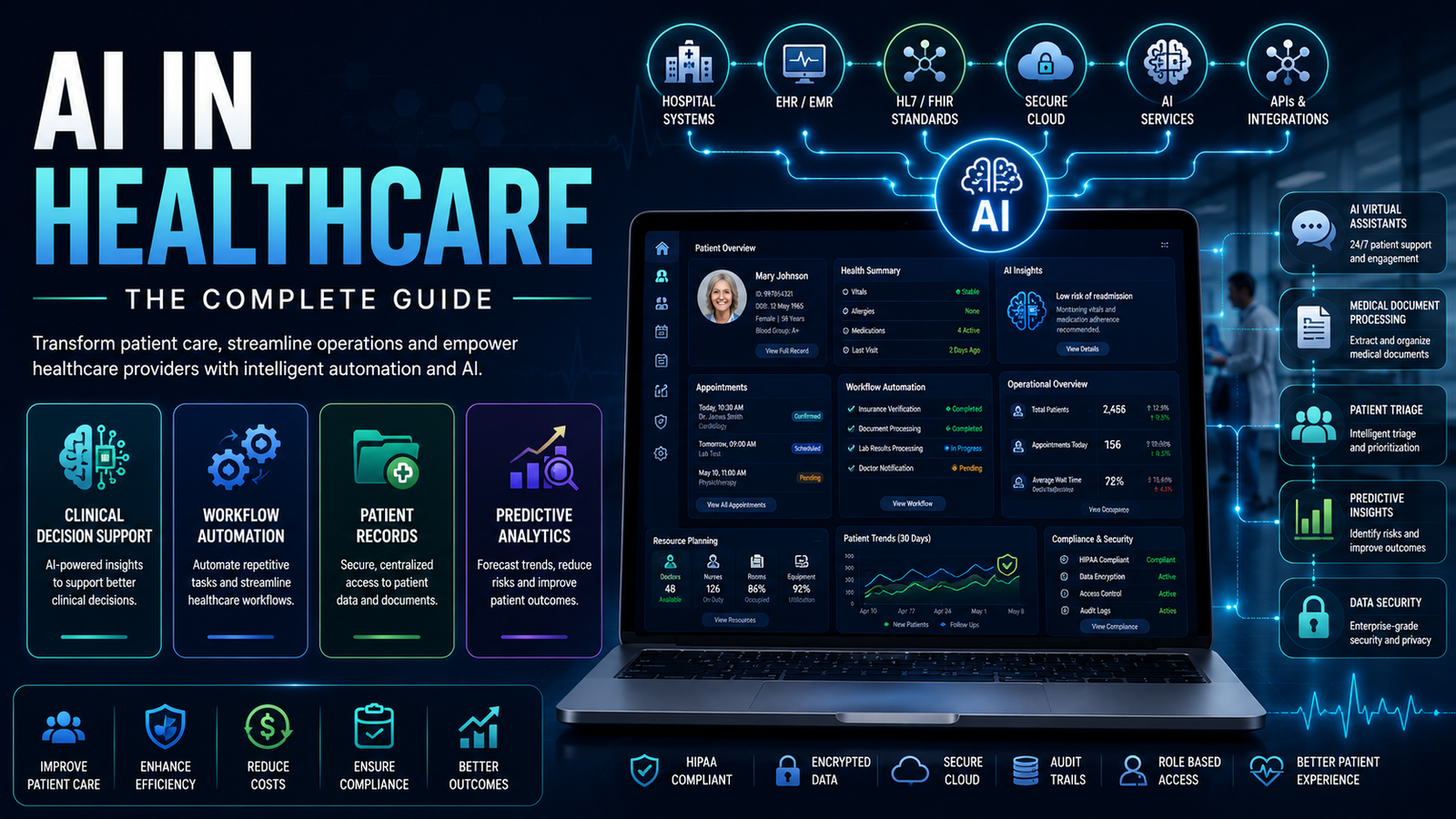
From intelligent appointment scheduling and AI-powered virtual assistants to predictive analytics, clinical decision support, and workflow automation, AI is enabling healthcare providers to operate more efficiently while improving the quality of care they deliver.
In this guide, we’ll explore how AI is transforming healthcare, why healthcare organizations are investing in intelligent automation, common AI applications, implementation best practices, compliance considerations, and how healthcare providers can successfully adopt AI-driven technologies.
Why Healthcare Needs AI
Healthcare organizations generate enormous volumes of data every day. Patient records, appointment schedules, laboratory results, medical imaging, prescriptions, billing information, compliance documentation, and operational reports all require continuous management and coordination.
Many organizations still rely on manual administrative processes that consume valuable staff time and increase the likelihood of errors.
Common challenges include:
- Administrative overload
- Long appointment scheduling times
- Manual document processing
- Limited access to patient information
- Repetitive data entry
- Staffing shortages
- Increasing operational costs
- Regulatory compliance requirements
- Fragmented healthcare systems
- Delayed clinical decision-making
Artificial Intelligence helps healthcare providers reduce administrative workloads while enabling clinicians to focus more time on delivering patient care.
What Is AI in Healthcare?
AI in Healthcare refers to the use of Artificial Intelligence technologies to improve healthcare operations, automate business processes, analyze medical and operational data, and support healthcare professionals with intelligent decision-making.
Modern AI solutions assist organizations by:
- Automating repetitive administrative work
- Organizing medical information
- Supporting clinical decision-making
- Improving operational efficiency
- Enhancing patient communication
- Optimizing healthcare workflows
- Improving reporting and analytics
- Supporting compliance activities
AI complements healthcare professionals by improving access to information and streamlining day-to-day operations rather than replacing clinical expertise.
Key AI Applications
Healthcare organizations are implementing AI across multiple operational and clinical functions.
Intelligent Appointment Scheduling
AI automates appointment booking, reminders, cancellations, and rescheduling while reducing administrative workload and improving patient attendance.
Medical Document Processing
AI automatically processes referral letters, discharge summaries, insurance documents, consent forms, and medical reports, reducing manual paperwork and improving accessibility.
Clinical Decision Support
AI helps clinicians quickly retrieve relevant patient information, summarize historical records, identify trends, and provide evidence-based insights that support informed medical decisions.
Patient Triage
AI-powered virtual assistants collect patient information, identify priority cases based on predefined criteria, and route patients to the appropriate healthcare services.
AI Virtual Assistants
Healthcare chatbots assist patients by answering common questions, providing appointment information, delivering pre-visit instructions, and supporting patient communication outside normal office hours.
Predictive Analytics
AI analyzes operational and historical healthcare data to forecast patient demand, optimize staffing, identify resource requirements, and improve operational planning.
Workflow Automation
Routine administrative tasks such as approvals, notifications, patient onboarding, document routing, billing updates, and internal communication are automated through intelligent workflows.
Knowledge Search
AI-powered search platforms allow clinicians and administrators to quickly locate medical policies, procedures, treatment guidelines, and internal documentation using natural language.
Benefits for Healthcare Providers
Organizations implementing AI solutions often experience measurable improvements across their operations.
Key benefits include:
- Improved staff productivity
- Reduced administrative workload
- Faster document processing
- Better access to patient information
- Improved reporting
- Enhanced operational visibility
- More efficient resource planning
- Reduced operational costs
- Stronger compliance management
- Better clinical decision support
Rather than increasing administrative complexity, AI enables healthcare professionals to focus on delivering quality patient care.
Benefits for Patients
Patients also benefit significantly from AI-powered healthcare solutions.
Common improvements include:
- Faster appointment scheduling
- Shorter response times
- Improved communication
- Personalized patient experiences
- Better care coordination
- Reduced waiting times
- More consistent service delivery
- Easier access to healthcare information
- Improved patient satisfaction
AI helps create a smoother and more efficient healthcare experience while maintaining the important relationship between patients and healthcare professionals.
Technology Stack
Modern healthcare AI solutions use secure enterprise technologies capable of supporting sensitive healthcare environments.
Common technologies include:
- OpenAI
- Claude
- Python
- FastAPI
- HL7/FHIR Integrations
- Microsoft Power Platform
- PostgreSQL
- REST APIs
- Workflow Automation Platforms
- Secure Cloud Infrastructure
These technologies enable healthcare organizations to develop scalable, secure, and intelligent solutions while integrating with existing healthcare systems.
Implementation Best Practices
Successful AI adoption requires careful planning and collaboration between technical teams and healthcare professionals.
Recommended best practices include:
- Define measurable business objectives.
- Identify high-impact administrative processes.
- Integrate existing healthcare systems.
- Protect sensitive patient information.
- Involve clinicians throughout implementation.
- Train employees on AI-assisted workflows.
- Monitor AI performance continuously.
- Maintain governance and oversight.
- Continuously optimize business processes.
Following these practices improves adoption while ensuring AI delivers measurable business value.
Challenges and Compliance
Healthcare organizations operate within highly regulated environments where security, privacy, and governance are essential.
Successful AI implementations should prioritize:
- Data privacy
- Role-based access controls
- Encryption
- Audit trails
- Secure authentication
- Regulatory compliance
- Responsible AI practices
- Continuous monitoring
- Human oversight for clinical decisions
AI should support healthcare professionals while ensuring clinicians remain responsible for final medical decisions.
Why Choose AK Consultant LLC
At AK Consultant LLC, we develop secure AI solutions that help healthcare organizations modernize operations, automate workflows, integrate enterprise systems, and improve operational efficiency.
Our expertise includes:
- Healthcare Workflow Automation
- AI Decision Support
- Enterprise Software Development
- AI Agents
- Microsoft Power Platform
- API Integration
- Document Intelligence
- Healthcare Knowledge Platforms
- Custom Business Applications
- Enterprise System Integration
We build scalable AI solutions tailored to the operational needs of hospitals, clinics, diagnostic centers, and healthcare organizations.
Frequently Asked Questions
Can AI replace doctors?
No. AI supports healthcare professionals by improving access to information, automating repetitive administrative work, and providing decision support. Clinical decisions remain the responsibility of qualified healthcare professionals.
Can AI integrate with existing healthcare software?
Yes. Modern AI solutions integrate with existing healthcare applications using standards-based integrations, APIs, and secure enterprise architectures.
Is patient information protected?
Yes. Enterprise healthcare AI solutions implement strong security controls including encryption, authentication, role-based permissions, audit logging, and governance policies.
Is AI suitable for small healthcare organizations?
Absolutely. AI solutions can scale from small clinics to large healthcare networks depending on operational requirements.
How long does implementation take?
Implementation timelines depend on organizational size, system integrations, and business objectives. Many healthcare providers begin with targeted automation projects before expanding AI across additional departments.
Conclusion
Artificial Intelligence is transforming healthcare by reducing administrative burdens, improving operational efficiency, supporting healthcare professionals, and enhancing patient experiences. Organizations that strategically implement AI and intelligent automation can streamline workflows, improve access to information, strengthen compliance, and create more connected healthcare operations.
Rather than replacing clinicians, AI enables healthcare teams to spend less time managing repetitive administrative tasks and more time delivering exceptional patient care.
Ready to Modernize Healthcare Operations with AI?
At AK Consultant LLC, we help healthcare organizations implement secure AI solutions that automate workflows, improve operational efficiency, integrate healthcare systems, and support better decision-making.
Whether you’re looking to streamline administrative processes, develop intelligent healthcare applications, implement workflow automation, or build AI-powered enterprise solutions, our team is ready to help.
Book your free Discovery Call today and discover how AI can transform your healthcare organization.