
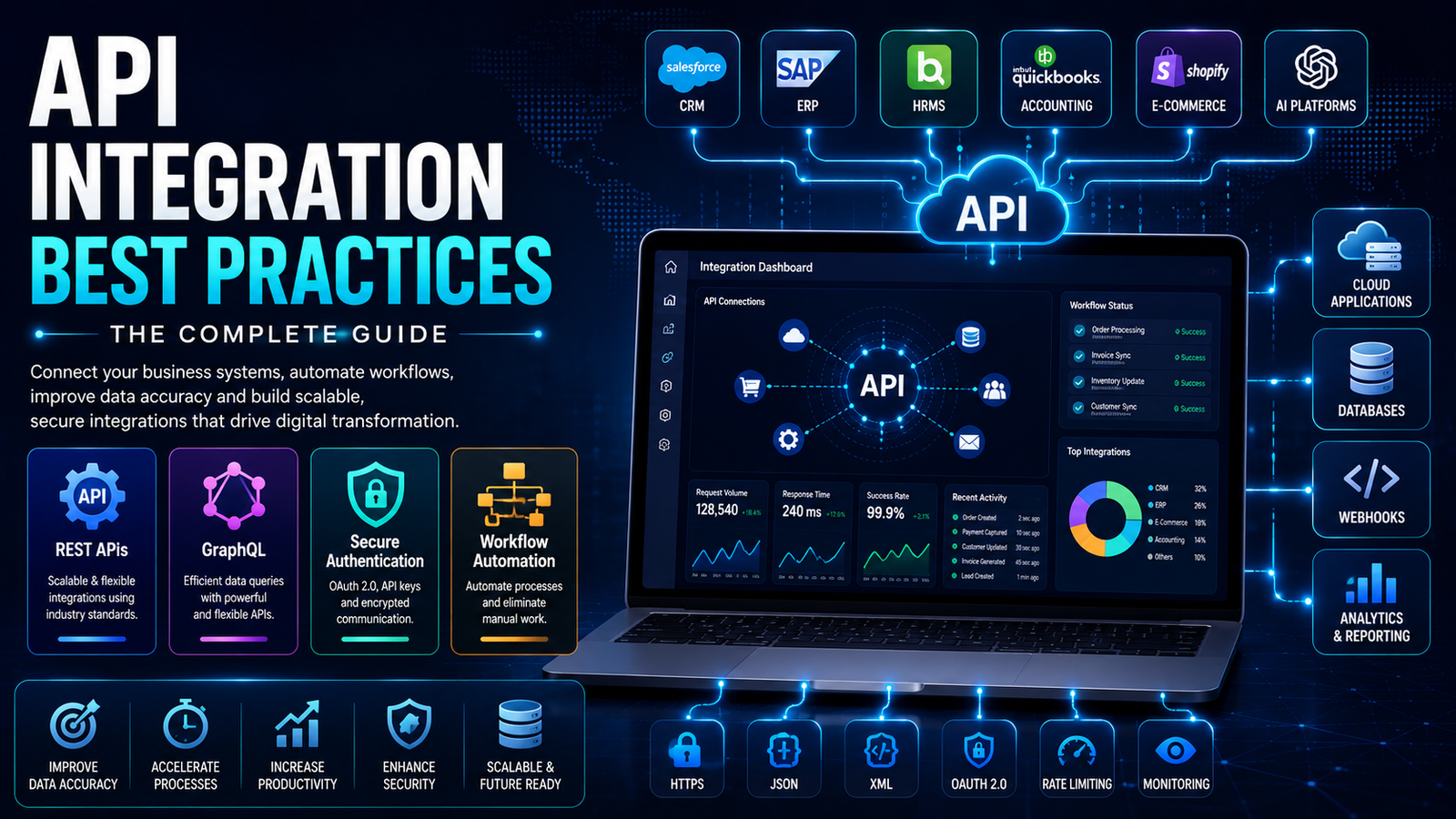
Modern businesses rely on a wide range of software applications to manage daily operations. Customer Relationship Management (CRM) systems, Enterprise Resource Planning (ERP) platforms, accounting software, HR applications, e-commerce stores, payment gateways, marketing automation tools, and Artificial Intelligence solutions all play a critical role in business success. However, these systems often operate independently, creating information silos that reduce productivity and increase operational costs.
Without seamless communication between applications, employees spend valuable time manually transferring data, updating multiple systems, correcting inconsistencies, and generating reports. These repetitive tasks not only reduce efficiency but also increase the risk of human error and poor decision-making.
This is where API Integration becomes essential.
Application Programming Interfaces (APIs) enable different software applications to communicate securely, exchange data in real time, and automate business processes without manual intervention. Whether integrating Salesforce with an ERP platform, synchronizing Shopify orders with inventory management, or connecting AI-powered applications to internal business systems, APIs create the foundation for modern digital transformation.
In this guide, we’ll explore what APIs are, why API integrations matter, common integration scenarios, best practices, security considerations, business benefits, industry use cases, and how organizations can build scalable connected business systems.
What Is an API?
An Application Programming Interface (API) is a secure set of rules and protocols that allows two or more software applications to communicate and exchange information automatically.
Instead of requiring manual data entry between systems, APIs enable applications to send and receive information in real time. They define how software requests data, processes information, and returns responses while maintaining security and consistency.
APIs are the backbone of modern digital ecosystems, enabling businesses to connect cloud applications, enterprise systems, mobile apps, websites, AI platforms, and third-party services.
Common systems connected through APIs include:
- Customer Relationship Management (CRM)
- Enterprise Resource Planning (ERP)
- Accounting Software
- Human Resource Management Systems
- E-commerce Platforms
- Payment Gateways
- Marketing Automation Tools
- AI Platforms
- Document Management Systems
- Business Intelligence Solutions
By connecting these systems, organizations eliminate repetitive tasks and create seamless digital workflows across departments.
Why API Integrations Matter
As organizations adopt more software solutions, disconnected systems quickly become a major operational challenge.
Without API integrations, businesses often experience:
- Duplicate data entry
- Inconsistent customer information
- Delayed reporting
- Manual approvals
- Poor collaboration
- Data silos
- Higher operational costs
- Slower customer response times
- Limited business visibility
API integrations solve these problems by creating a single connected ecosystem where information moves securely and automatically between applications.
This allows every department to work with accurate, up-to-date data while reducing manual effort and improving operational efficiency.
Common Business Integrations
Modern businesses integrate dozens of applications using secure APIs.
CRM + ERP
Synchronize customer records, quotations, invoices, purchase orders, and financial information between sales and operations.
HubSpot + Marketing Platforms
Automatically transfer leads, campaign performance, customer engagement data, and marketing analytics into centralized business systems.
Stripe + Accounting Software
Automatically reconcile online payments, invoices, subscriptions, and financial transactions.
Microsoft 365 + SharePoint
Synchronize documents, approvals, collaboration, and enterprise content management.
Shopify + Inventory Management
Automatically update inventory levels, order fulfillment, shipping information, and product availability.
AI + Knowledge Management Systems
Connect AI models with internal documentation, policies, customer records, and enterprise knowledge bases to provide intelligent assistance and automated decision-making.
These integrations reduce manual work while creating a connected technology ecosystem.
API Integration Best Practices
Successful API integrations require careful planning, secure architecture, and ongoing monitoring.
Use Secure Authentication
Implement secure authentication methods such as OAuth 2.0, API keys, and token-based authentication to protect sensitive business data.
Document Every Integration
Maintain comprehensive API documentation to simplify maintenance, onboarding, and future development.
Validate Incoming Data
Verify all incoming information before processing it to maintain data quality and reduce errors.
Handle Errors Gracefully
Implement proper error handling, retry mechanisms, and logging to improve reliability and troubleshooting.
Monitor API Performance
Track response times, uptime, request volumes, and system performance to identify potential issues before they affect operations.
Implement Version Control
Support API versioning to maintain compatibility while introducing new features and enhancements.
Design for Scalability
Build integration architectures that can support increasing users, transactions, and connected applications as the business grows.
Test Thoroughly
Perform functional, integration, security, and performance testing before deploying APIs into production environments.
Following these best practices helps organizations build reliable and future-ready integration solutions.
Business Benefits
Organizations implementing secure API integrations achieve significant operational improvements.
Key benefits include:
- Improved data accuracy
- Reduced manual work
- Faster business processes
- Increased employee productivity
- Better customer experiences
- Real-time information sharing
- Lower operational costs
- Improved collaboration
- Enhanced reporting
- Scalable digital infrastructure
Rather than maintaining disconnected software applications, businesses create a connected digital ecosystem capable of supporting automation, AI, and long-term growth.
Industry Use Cases
Healthcare
Healthcare providers synchronize patient records, appointment systems, billing platforms, and clinical applications to improve patient care and administrative efficiency.
Financial Services
Banks and financial institutions automate payment processing, account reconciliation, customer onboarding, compliance monitoring, and reporting.
Manufacturing
Manufacturers connect production planning, procurement, inventory management, quality assurance, and logistics systems.
Logistics
Logistics companies integrate warehouse management, shipment tracking, fleet management, and customer communication platforms.
Retail & E-commerce
Retail businesses synchronize online stores, inventory management, payment gateways, customer databases, and shipping providers to improve operational efficiency and customer satisfaction.
Professional Services
Consulting firms, accounting firms, and legal practices automate client onboarding, project management, document management, billing, and reporting.
Technology Stack
Modern API integrations rely on enterprise-grade technologies designed for scalability and security.
Common technologies include:
- REST APIs
- GraphQL
- Webhooks
- OAuth 2.0
- OpenAPI
- Python
- FastAPI
- Laravel
- Node.js
- Microsoft Power Automate
- n8n
- Azure
- AWS
- PostgreSQL
- Enterprise Cloud Platforms
Selecting the right technology stack ensures secure, maintainable, and high-performance integrations.
Security Considerations
Security is one of the most critical aspects of API integration.
Organizations should implement:
- Secure authentication
- Data encryption
- Role-based access control
- API rate limiting
- Audit logging
- Continuous monitoring
- Threat detection
- Secure API gateways
- Regular security testing
A strong security strategy protects sensitive information while maintaining regulatory compliance and customer trust.
Why Choose AK Consultant LLC
At AK Consultant LLC, we design, develop, and implement secure API integration solutions that connect enterprise applications, automate workflows, and improve operational efficiency.
Our expertise includes:
- Enterprise API Development
- Workflow Automation
- AI Agent Integration
- Microsoft Power Platform
- OpenAI Integration
- CRM & ERP Integration
- Cloud Application Integration
- Enterprise Software Development
- AI SaaS Platforms
- Business Process Automation
We build scalable integration solutions that eliminate manual work, improve data accuracy, and enable organizations to create connected digital ecosystems ready for future growth.
Frequently Asked Questions
What is an API Integration?
API Integration allows different software applications to communicate securely and exchange information automatically, eliminating manual data entry and improving operational efficiency.
Can legacy systems be integrated?
Yes. Many legacy systems can be integrated using APIs, middleware, or custom connectors depending on their capabilities.
Are API integrations secure?
Yes. Modern API integrations use authentication, encryption, role-based permissions, monitoring, and secure communication protocols to protect business data.
Can API integrations be customized?
Absolutely. Integrations can be designed specifically around your organization’s workflows, systems, and business objectives.
How long does an API integration project take?
Project timelines depend on the number of systems, integration complexity, and business requirements. Many organizations begin with high-priority integrations and expand incrementally.
Conclusion
API integrations are the foundation of modern digital business. By connecting software applications, automating data flows, and eliminating information silos, organizations improve operational efficiency, reduce costs, strengthen collaboration, and prepare their technology ecosystem for AI, automation, and future innovation.
Businesses that invest in secure, scalable API integrations today build the connected infrastructure needed to support long-term digital transformation and sustainable growth.
Ready to Connect Your Business Systems?
At AK Consultant LLC, we help organizations design, develop, and implement secure API integrations that connect enterprise applications, automate workflows, improve data accuracy, and accelerate digital transformation.
Whether you’re integrating CRM, ERP, finance, HR, AI platforms, or custom business applications, our team is ready to build a scalable integration solution tailored to your business.
Book your free Discovery Call today and discover how API Integration can transform your business.